How to store dahlia tubers over winter
Oct 2, 2026 · 9 min read
How to store dahlia tubers: dig after the first frost, dry for a few hours, pack in vermiculite or wood shavings and keep them at 34 to 40 °F until spring.
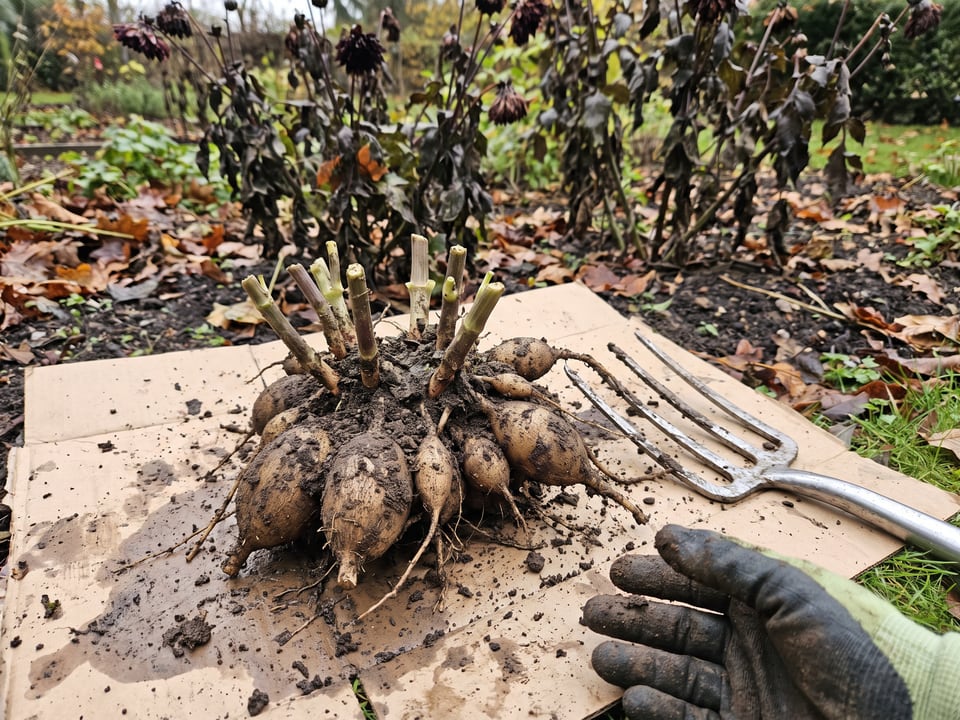
To store dahlia tubers, dig the clumps after frost has blackened the tops, knock off the soil, let them dry for a few hours, then pack them in a box of vermiculite, coir or wood shavings and keep them at 34 to 40 °F (1 to 4 °C). Check them about once a month. Shriveled tubers get a light mist, and soft or moldy ones go in the trash. In spring you divide the clumps and plant them again after your last frost.
The rest of this guide goes through each of those steps in the order you meet them in the fall, and ends with the case where you can skip digging altogether.
Are dahlias annuals or perennials?
Dahlias are tender perennials. The tuberous roots live for years, but they die if the soil around them freezes, so across most of the US gardeners treat them like annuals that get dug and replanted every year. The University of Georgia puts it plainly: dahlias are not reliably winter hardy outside Zone 9 unless they are heavily mulched. For how that compares with plants that really do come back on their own, see annuals vs. perennials.
In the catalog, the hardiness range on each dahlia record shows the same limit. Café au Lait and Bishop of Llandaff are listed from zone 8, and Arabian Night from zone 9. North of those zones, you dig.
When to dig up dahlias
Dig dahlias after the first frost has killed the foliage and before the ground freezes hard. University of Wisconsin Extension says to dig before a hard freeze or let a light frost kill the tops first.
Oregon State University’s dahlia guide suggests a short wait, though Wisconsin Extension says to dig within a few days of frost so rot organisms do not enter through the damaged tops. After frost kills the stalks, cut them back to 4 to 6 inches (10 to 15 cm) and, if no hard freeze is forecast, leave the clumps in the ground for three to seven days. In that time the eyes swell and become easier to spot, which helps if you plan to divide in fall (OSU FS 95).
Your first frost date sets the calendar. Look up the average date for your ZIP code with the first frost date tool, or use the bulb planting and digging calendar, which gives the dahlia digging window next to the tulip and daffodil planting dates.
How to dig up dahlia tubers without damaging them
Start about 18 inches (45 cm) out from the stalk, as OSU recommends, and work your way around the clump with a fork or spade before lifting. The tubers hang from a short neck, and that neck is the weak point. A tuber with a broken neck may not grow, so OSU says to throw those away.
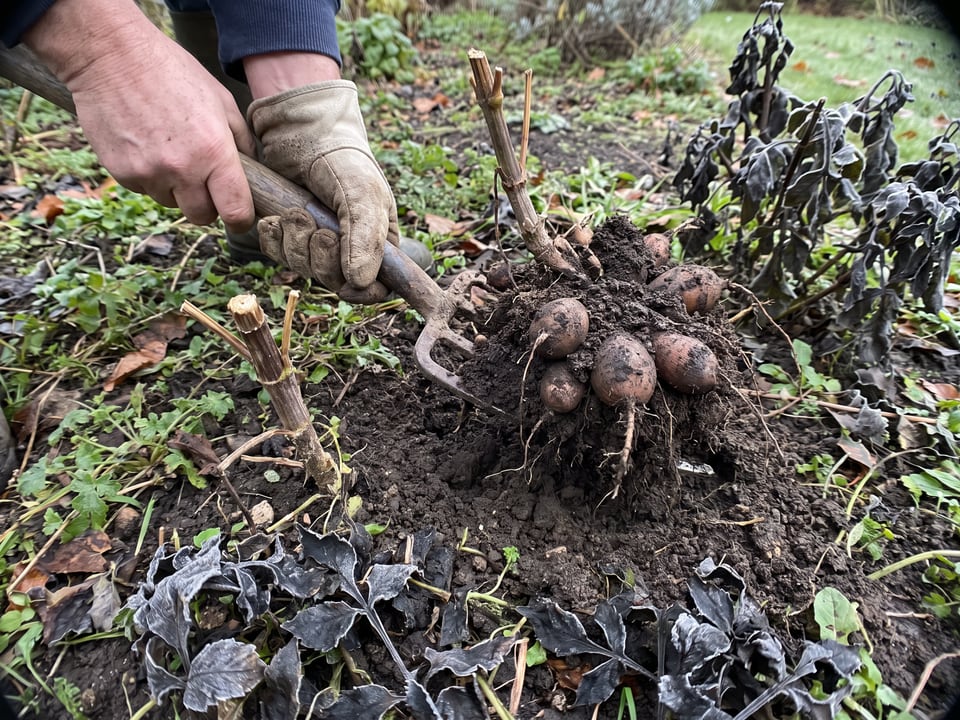
Lift the whole clump by getting under it, not by pulling the stalk. Wisconsin Extension notes that the roots bruise easily, and bruises are where rot starts in storage.
Shake off as much soil as you can in the garden. OSU advises removing as much soil as possible while still in the garden and avoiding sharp tools, which damage the skin and affect how well the tubers store.
Should you wash dahlia tubers before storing?
Both approaches work, and the choice depends on when you divide.
If you divide in fall, wash the clumps, let them air dry, divide them and store the pieces. OSU suggests rinsing the divisions in a 10% bleach solution and drying them on a mesh screen before packing.
If you divide in spring, skip the washing. OSU describes storing whole, unwashed clumps in cardboard boxes at 34 to 40 °F (1 to 4 °C).
Whichever you choose, let the tubers dry before they go into storage. Wisconsin Extension asks for several hours. The surface should be dry to the touch, and the tubers should still feel firm.
How to store dahlia tubers for the winter
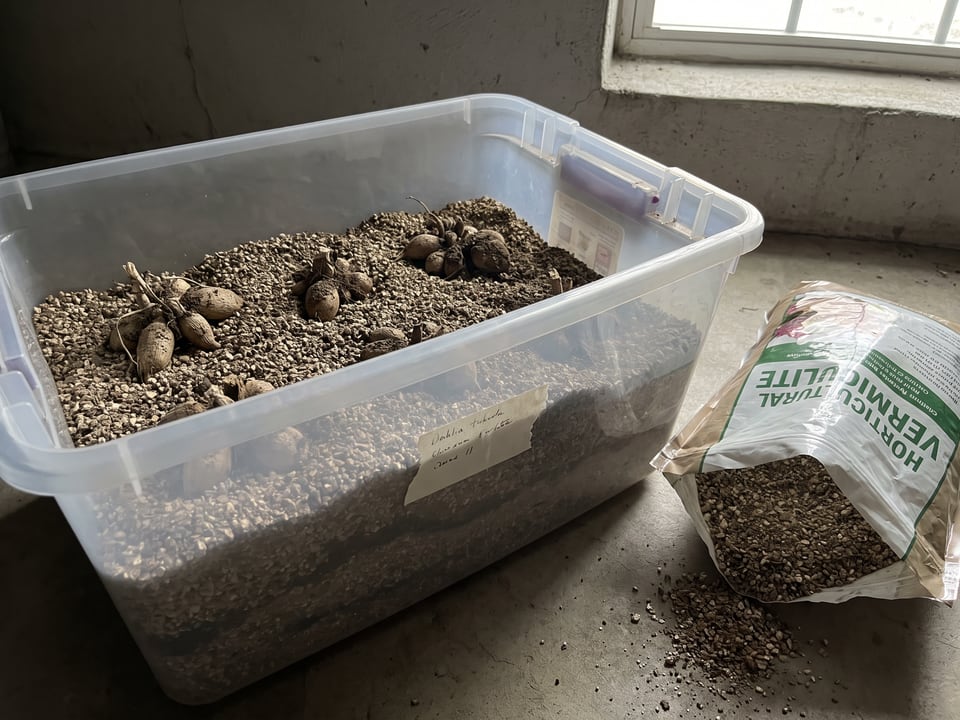
Pack the tubers so they do not touch each other, in a material that holds a little moisture without staying wet. The sources name these:
| Storage medium | Recommended by |
|---|---|
| Vermiculite | Wisconsin, OSU |
| Coconut coir | Wisconsin, OSU |
| Wood shavings | Wisconsin, OSU |
| Peat moss | Wisconsin |
| Sand | Wisconsin |
| Sawdust | Wisconsin |
Wisconsin suggests layering bulbs and tubers in the medium 2 to 3 inches (5 to 8 cm) deep. If you use plastic bags, OSU says to leave them open so condensation does not build up inside.
What temperature to store dahlia tubers
Aim for 34 to 40 °F (1 to 4 °C), the range OSU gives for dahlias. Wisconsin gives a slightly wider range for tender bulbs in general, 35 to 45 °F (2 to 7 °C) with about 50% relative humidity. The overlap, 35 to 40 °F (2 to 4 °C), satisfies both sources.
Can you store dahlia tubers in the garage?
Yes, as long as the garage stays within the 34 to 45 °F (1 to 7 °C) band all winter and never drops to freezing. Garages vary a lot, so put a min/max thermometer next to the box for the first few weeks and move the tubers to a basement or cool closet if the reading falls out of range.
Check the tubers every month
Open the box about once a month. Wisconsin Extension recommends looking for dehydration and misting lightly if the tubers have started to wrinkle. OSU also says to watch for condensation and rot. Soft, mushy or moldy tubers should come out right away so the rot doesn’t spread to the rest of the box.
Toward the end of winter, OSU suggests moving the tubers to a slightly warmer spot, 40 to 50 °F (4 to 10 °C), in March or April so the eyes start to form before planting.
How to divide dahlia tubers
Each division needs three parts: a tuber, an intact neck, and a piece of crown with at least one eye. OSU describes the crown as a bulging ridge around the neck, the thin portion of the tuber. Eyes form on the crown, first as small bumps and later as sprouts. A tuber with no eye will not produce a plant, however large it is.
To divide:
- Remove tubers with broken necks.
- Find the eyes on the crown. In fall they look like swollen bumps next to the stalk. By spring they look like the eyes on a sprouting potato.
- Cut through the crown with a clean, sharp knife so that each piece has a tuber, a neck and at least one eye.
- Let the cut surfaces dry before storing or planting.
Divide in fall or in spring?
The sources disagree slightly on timing, and both have a point. Wisconsin Extension says the eyes are easier to see in fall, while OSU says they are easier to see in spring but that spring division can be more challenging, and that fall is the most common time to divide. Wisconsin Extension still recommends waiting until spring, because whole clumps spoil less in storage than cut pieces. If you are new to dahlias, store whole clumps and divide in spring once the eyes are obvious.
Can you leave dahlias in the ground over winter?
In zone 9 and warmer you can leave dahlias in the ground. In zones 7 and 8 you can, with protection and some risk. North of that, dig them.
OSU’s method for leaving dahlias in the ground from zone 7 up:
- After the first frost, cut the stems down to ground level.
- Cover the bed with 6-mil black plastic.
- Pile at least 4 inches (10 cm) of organic mulch or leaves on top.
- Dig and divide every three years so the clumps don’t get crowded.
UGA’s guidance matches this: dahlias survive outside zone 9 only when heavily mulched. OSU also says to pick an area that drains well and has no standing water.
Can I leave dahlia tubers in pots over winter?
None of the sources we used covers storing dahlias in their pots. For dug tubers, OSU recommends a dark place that will not freeze, ideally 34 to 40 °F (1 to 4 °C). Short border dahlias such as Gallery Singer are small enough that storing them in the pot is easy.
Why do dahlia tubers rot or shrivel in storage?
Rot usually points to moisture and shriveling to dryness. The fixes below come straight from the Wisconsin and OSU guidance:
| Problem | Likely cause | Fix |
|---|---|---|
| Soft, mushy tubers | Stored before drying, sealed bags, bruising | Dry for several hours, leave bags open, handle gently |
| Wrinkled, hollow tubers | Storage too dry, wood shavings as the medium, or too much nitrogen in summer (OSU) | Keep at 34 to 45 °F, mist lightly once a month |
| Tuber alive but no sprout | No eye on the division | Divide with a piece of crown and an eye |
| Tubers dead after winter | Froze in storage | Keep above 32 °F (0 °C) |
Firm tubers are worth keeping. Soft ones are what both extension services tell you to watch for and remove.
Getting the tubers back in the ground
In spring, OSU says to plant tubers outside when the soil is around 60 °F or warmer for several days in a row, usually between late April and the end of May in Oregon. The spring flower planting calendar gives the earliest planting date for your ZIP code. Depth, spacing and staking are covered in how to plant dahlia tubers.
Keep labels with every clump through the winter. Tall ball dahlias such as Cornel and small pompons such as Chick A Dee look the same as tubers in a box, and a named tag is the only way to know which is which in May.
If you also grow spring bulbs, the digging window overlaps with tulip planting time. The tulip planting guide covers that half of the fall bulb calendar.