How to plant daffodil bulbs: depth, spacing and aftercare
Oct 2, 2026 · 8 min read
How to plant daffodil bulbs: 6 to 8 inches deep, pointed end up, in fall while the soil is workable. Spacing, sun, choosing bloom times and care after flowering.
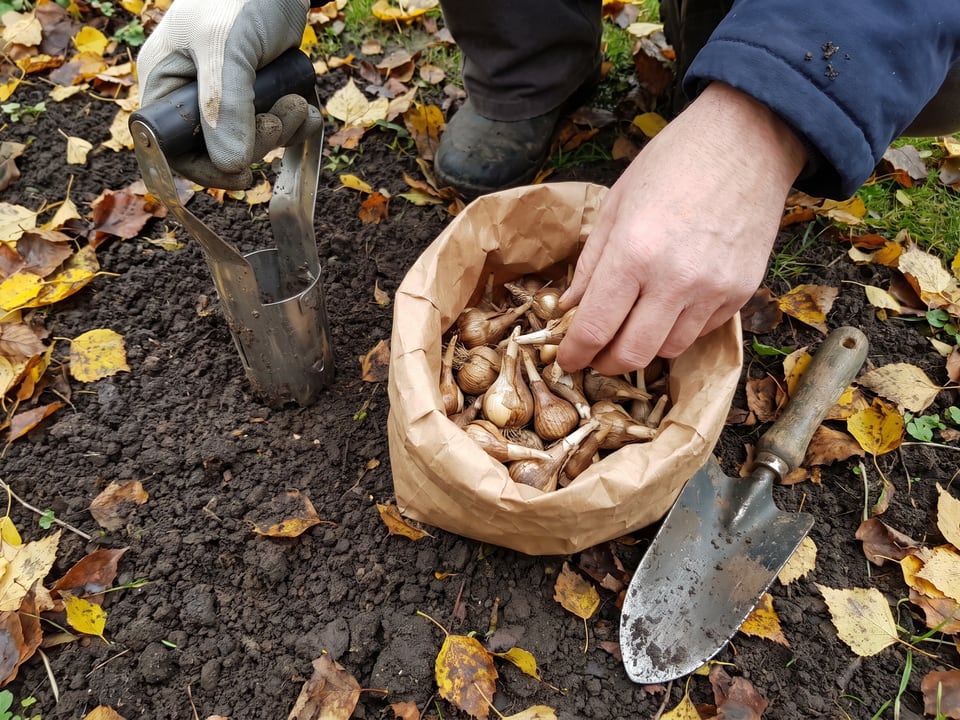
Plant daffodil bulbs in fall, while the soil is still workable and before the ground freezes. In cold regions that usually means September to October. In the South, October to November is the usual window, and Clemson moves most bulbs on the South Carolina coast to late December or early January. Planting before the ground freezes gives the bulbs time to root, and most spring bulbs need 12 to 16 weeks of cold to flower.
For a date tied to where you live, enter your ZIP code in the fall bulb planting calendar. It works from your local first frost date and hardiness zone.
Planting season by region
Most extension services give a regional window, not a single date. Here is what the sources used for this guide say:
| Region | Planting window | Source |
|---|---|---|
| Western Pennsylvania | September to October, before the first frost | Penn State Extension |
| Midwest (Illinois) | Fall, and most bulbs can go in until the ground is frozen | University of Illinois Extension |
| South Carolina, Upstate and Piedmont | October or November | Clemson HGIC |
| Georgia | October through late December in most areas | UGA Extension |
| Coastal South Carolina | Late December or early January for most bulbs | Clemson HGIC |
Penn State Extension explains the reason for planting ahead of frost: it gives the bulbs time to develop a solid root system before the ground freezes. If you don’t know your first frost date, look it up with the first frost date tool and count back from it.
Planting daffodils in the South
Daffodils are the easier fall bulb in warm climates. Clemson’s Home and Garden Information Center tells South Carolina gardeners to plant daffodils in October or November, and to wait with other spring bulbs until the soil at planting depth stays below 60 °F (16 °C). That makes daffodils the bulb you can plant first.
The same factsheet notes that most bulbs need a 12- to 16-week chilling period to flower, and that coastal gardeners can make sure of spring bloom by refrigerating bulbs in ventilated packages until planting. UGA Extension gives the refrigerator conditions: 12 to 16 weeks at 40 to 50 °F (4 to 10 °C). Pre-chilling comes up most often with tulips, as the tulip planting guide explains. For daffodils, check the zone range of the variety before you buy. Several tazetta and jonquilla types in the catalog are listed to zone 9 or 10, for example Canaliculatus (zones 6 to 10) and Baby Moon (zones 4 to 9), while a trumpet like King Alfred is listed only to zone 7.
How deep to plant daffodil bulbs
Plant standard daffodil bulbs 6 to 8 inches (15 to 20 cm) deep, measured from the bottom of the bulb. Clemson gives 6 to 8 inches and says to go shallower for small species bulbs. NC State Extension and the University of Illinois both give about 8 inches for large bulbs.
If your bulbs are unusually big or small, use a depth rule. Penn State says two and a half to three times the bulb’s height, Illinois two to three times its height, and Clemson three to four times its width. Miniatures such as Tete a Tete, which is listed at 6 to 8 inches (15 to 20 cm) tall, come from small bulbs and sit closer to the surface than a big trumpet like Dutch Master at 18 to 20 inches (46 to 51 cm).
How far apart to plant daffodils
Space daffodil bulbs 3 to 6 inches (8 to 15 cm) apart, closer for small bulbs and wider for large ones (Clemson). NC State gives 2 to 3 inches. Close spacing gives a full clump sooner. Wider spacing means the clump takes longer to crowd itself, which matters because daffodils multiply over the years.
Sun and soil
Choose a spot that gets at least six hours of sun a day while the plants are in leaf. Clemson puts the soil pH for most bulbs between 6 and 7.
How to plant daffodil bulbs, step by step
- Loosen the bed to at least the planting depth. Illinois recommends preparing a whole bed rather than digging single holes.
- Mix in fertilizer if you haven’t had a soil test. Clemson suggests a slow-release complete fertilizer worked into the root zone at planting, or 10-10-10 in fall, repeated when shoots appear in spring.
- Set each bulb pointed end up at 6 to 8 inches deep.
- Cover, firm the soil, and water well. Penn State advises watering bulbs whenever the soil is dry.
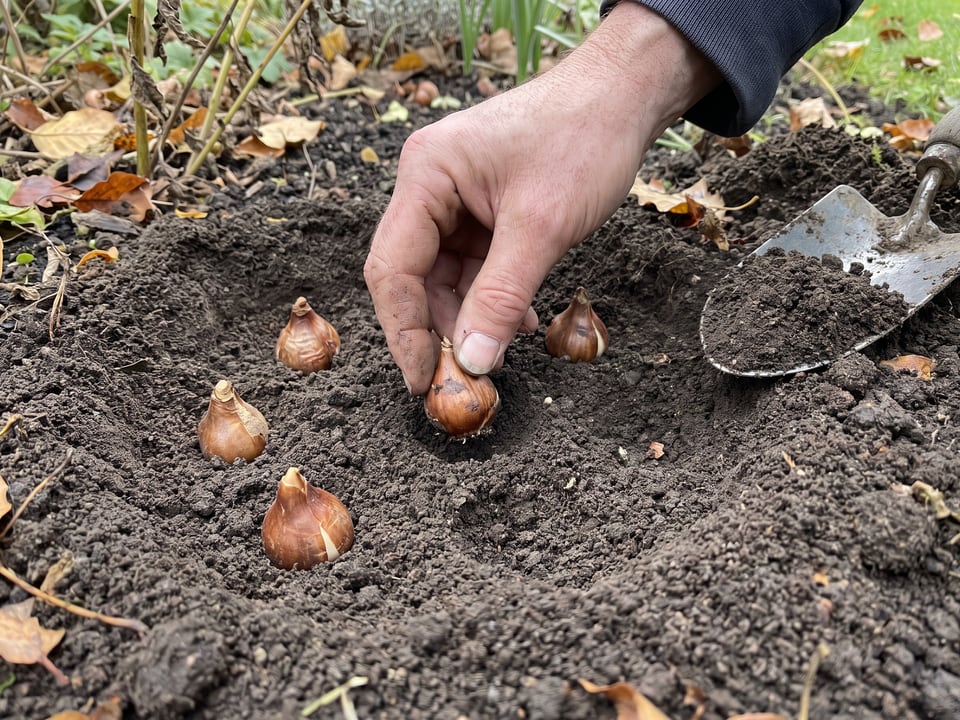
Deer and rodents are rarely a problem. Clemson says animals rarely eat daffodil bulbs, and NC State describes daffodils as deer, rabbit and salt resistant. See more deer-resistant perennials.
Choosing daffodils for early, mid and late spring
“Daffodil” and “narcissus” name the same plants. Daffodils belong to the genus Narcissus in the amaryllis family, and NC State Extension lists 13 divisions based on flower shape and parentage (UGA Extension counts 11): trumpet, large-cupped, small-cupped, double, triandrus, cyclamineus, jonquilla, tazetta, poeticus, bulbocodium, split corona, miscellaneous and species.
All daffodils go into the ground at the same time in fall. The division and the variety decide when they flower, so planting a few types spreads the show over several weeks:
| Bloom time | Division | Example from the catalog | Listed height |
|---|---|---|---|
| Early spring | Cyclamineus | February Gold | 8 to 12 in (20 to 30 cm) |
| Early to mid spring | Double | Rip van Winkle | 5 to 8 in (13 to 20 cm) |
| Early to mid spring | Large-cupped | Ice Follies | 18 to 20 in (46 to 51 cm) |
| Mid to late spring | Triandrus | Thalia | 12 to 14 in (30 to 36 cm) |
| Mid to late spring | Poeticus | Actaea | 15 to 17 in (38 to 43 cm) |
| Late spring | Jonquilla | Quail | 16 to 18 in (41 to 46 cm) |
Browse the full list by division, height and zone on the daffodil hub.
Fall bulbs to plant alongside daffodils
Daffodils share their planting season with the other spring bulbs. Tulips follow the same fall calendar but have their own soil temperature rule, covered in the tulip guide, and you can compare them on the tulip hub. The bulb planting calendar shows daffodil and tulip windows side by side for your ZIP code.
What to do with daffodils after they bloom
After the flowers fade, leave the leaves alone until they turn yellow or brown. Clemson says to keep the foliage for at least six weeks after bloom or until it browns. The leaves make the food that is stored in the bulb for next year’s flowers, as Illinois puts it, so mowing them off early leaves a small, weak bulb.
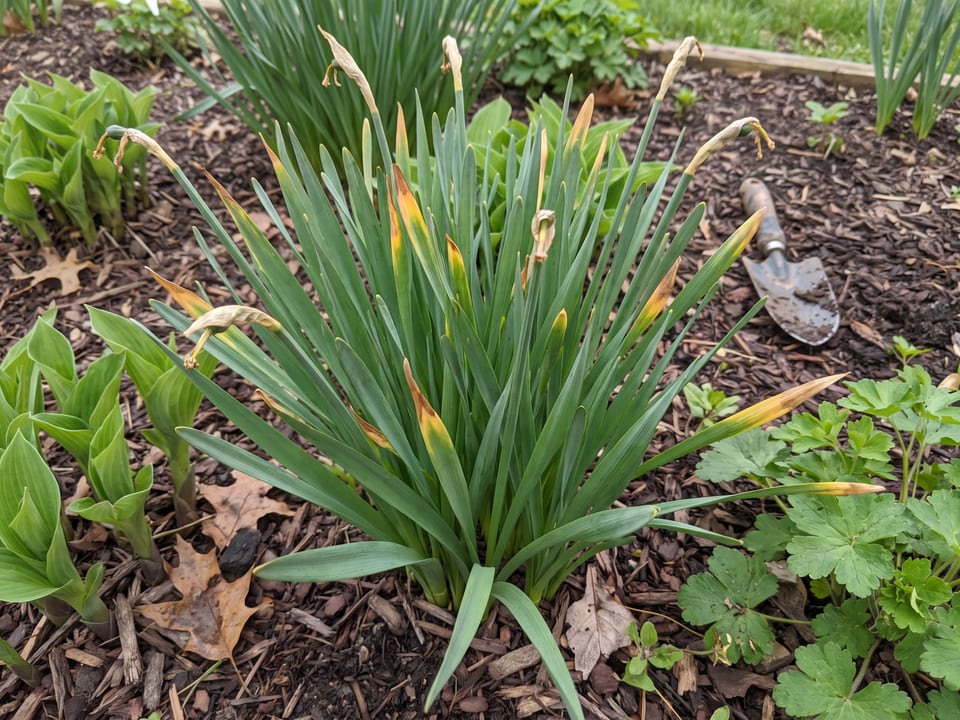
When to cut back daffodils
Cut the foliage once it has yellowed and died back on its own. UGA notes that the leaves of most spring bulbs die down by late spring or early summer. Illinois warns against mowing the leaves off before that point.
Do daffodils come back every year?
Yes. Daffodils are perennials and, left in the ground, return each spring (see annuals vs perennials for how that differs from dahlias and zinnias). Clumps get crowded over time. Illinois suggests digging and replanting daffodils every five years, and smaller flowers or uneven bloom are the sign that a clump needs it. NC State advises digging just after the foliage dies back. Replant the divided bulbs at the usual depth, either right away or in fall with the rest of your bulbs.
Can you plant daffodil bulbs in the spring?
Don’t hold them until spring. Iowa State Extension says unplanted tulip bulbs are likely to be dead by early spring and that long-term storage of spring-flowering bulbs is difficult. Plant forgotten bulbs as soon as you can, as late as December if the soil isn’t frozen, and cover the bed with a few inches of straw or leaves. If the ground has already frozen, Iowa State’s option for tulips is to pot them up and chill them for 12 to 16 weeks at 40 to 45 °F to flower indoors.
Are daffodils poisonous?
Yes. The ASPCA lists daffodils as toxic to dogs, cats and horses, with the bulbs the most poisonous part. NC State says they are toxic if large quantities are eaten and that handling them can irritate skin. NC State lists phenanthridine alkaloids and calcium oxalate crystals as the causes. Pet owners should read the guide to flowers toxic to cats.