How to plant hostas: timing, spacing, dividing, cutting back
Oct 2, 2026 · 7 min read
How to plant hostas: crown at soil level, a hole twice as wide as the roots, spring or early fall, 1 inch of water a week, and division every 4 to 5 years.
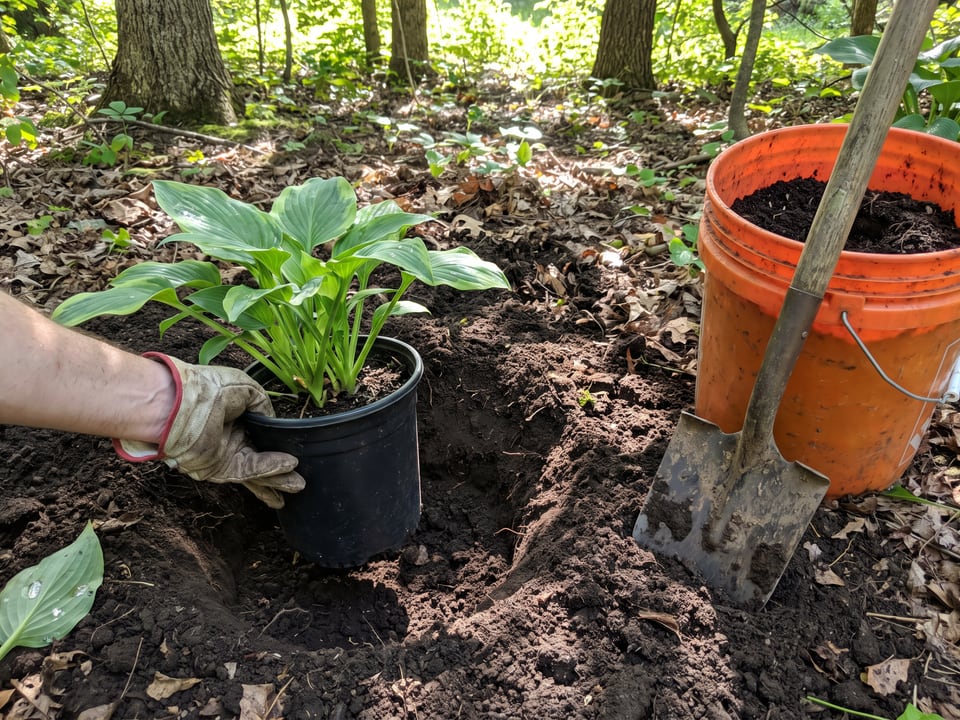
To plant a hosta, dig a hole as deep as the root ball and at least twice as wide, set the crown at the soil surface or slightly above it, backfill with soil amended with compost, and water well. Do it in early spring as the shoots emerge or in early fall, in a spot that gets shade in the afternoon. The rest of this guide covers timing, spacing by size, watering, dividing and fall cleanup.
When to plant hostas
The best time to plant hostas is early spring, when the leaves are just starting to come up. University of Georgia Extension gives that window for planting, transplanting and dividing alike. Clemson’s Home & Garden Information Center adds early fall as a second option, and in spring it says to do the job before the leaves unfold.
Spring is not the only window. SDSU Extension calls spring the best time but says hostas can go in throughout the growing season with care. A potted hosta bought in June needs regular watering through its first summer.
For early fall planting, give the roots a few weeks in warm soil before the ground freezes. The fall planting calendar shows your average first frost date by ZIP code.
When to transplant hostas
Transplant hostas at the same times you plant them: early spring as the shoots emerge, or early fall.
Where to plant hostas
Plant hostas where they get shade for part of the day, especially in the afternoon. UGA puts their light range at anywhere from partial sun to dense shade and warns against direct afternoon sun, which scorches and discolors leaves. SDSU describes them as plants that tolerate four hours of sun a day or less, with filtered light under trees or morning sun working for many cultivars.
Can hostas grow in full sun?
Some can, if they get enough water. A few cultivars in the catalog list full sun among their light conditions, including Sum and Substance, Royal Standard and Guacamole. Most list only part or full shade. Clemson notes that in full sun leaf color is pale and leaves may die back, especially during dry periods. For more shade plants to pair with them, browse perennials for shade.
How to plant hostas step by step
- Prepare the soil. Hostas prefer well-drained soil amended with organic matter such as compost or rotted manure (UGA). A soil test tells you whether you need lime or fertilizer.
- Dig the hole. UGA says as deep as the root ball and at least twice as wide. SDSU says about 12 inches deep and one and a half times the size of the pot.
- Set the crown at soil level. The crown is where the roots meet the shoots. SDSU says it should sit at the surface or slightly above.
- Backfill and firm. Fill around the roots with the amended soil and press gently to remove air pockets.
- Fertilize lightly. UGA suggests 1/2 lb of 10-10-10 per 100 sq ft at planting or when growth emerges in spring. A slow-release fertilizer works too.
- Water and mulch. Soak the planting area, then mulch around the plant to hold moisture.
How far apart to plant hostas
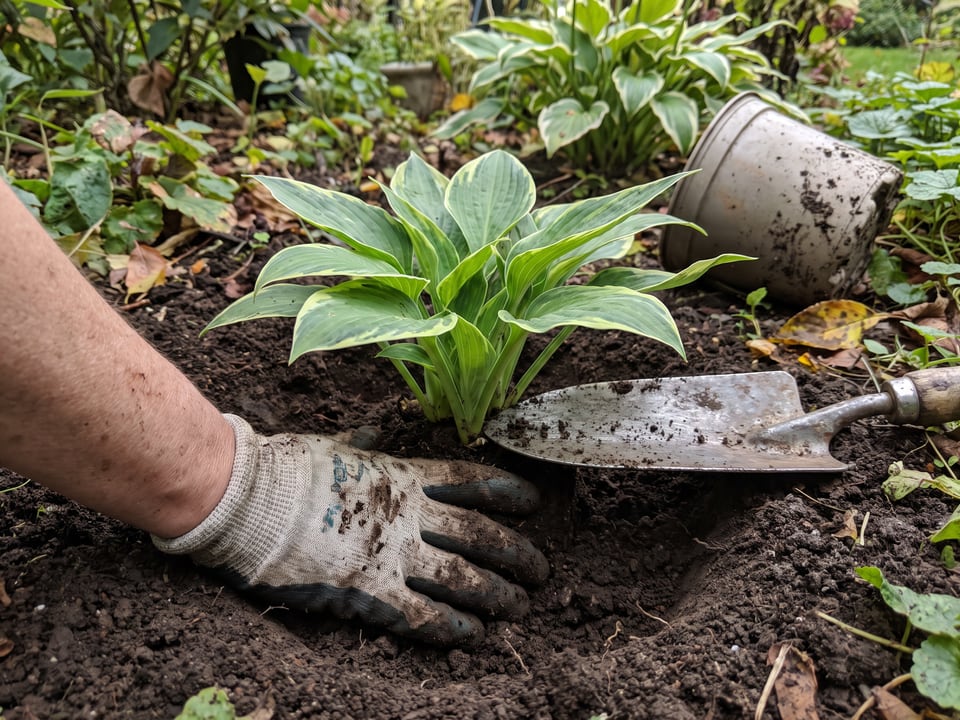
Space hostas by their spread at maturity. Clemson’s general range is 1 to 3 feet (30 to 90 cm) apart, which covers most garden hostas, but the size class of the cultivar matters more than any single number. SDSU groups hostas by height into miniature (under 10 inches), small (10 to 15 inches), medium (15 to 22 inches) and large (over 22 inches).
Spread figures from catalog records show how wide the range gets:
| Cultivar | Size class | Height | Mature spread |
|---|---|---|---|
| Church Mouse | Mini | 8 in (20 cm) | 14 in (36 cm) |
| Lakeside Paisley Print | Small | 10 in (25 cm) | 20 to 30 in (51 to 76 cm) |
| Halcyon | Medium | 14 to 18 in (36 to 46 cm) | 30 to 36 in (76 to 91 cm) |
| Royal Standard | Large | 26 in (66 cm) | 60 to 63 in (152 to 160 cm) |
| Blue Angel | Giant | 36 in (91 cm) | 48 in (122 cm) |
| Sum and Substance | Giant | 36 in (91 cm) | 60 to 72 in (152 to 183 cm) |
Set plants roughly their mature spread apart, center to center. A row of Church Mouse can go about a foot apart. A giant like Sum and Substance needs 5 feet or more. Clemson also suggests wider spacing as one way to reduce slug damage.
How often to water hostas
Hostas need about 1 inch of water per week when rain doesn’t supply it. SDSU and Clemson both give that figure, and Clemson adds that plants need more in hot weather or when tree roots compete for moisture. Water deeply and less often. SDSU says this works better than frequent shallow watering. UGA’s advice is to keep the soil moist, never soggy.
When to divide hostas
Divide hostas in early spring, when the shoots are just coming up, or in early fall. UGA says most cultivars can be divided every four to five years, depending on how vigorous the clump is. Clemson notes that hostas do best when left undisturbed for several years.
How to divide hostas
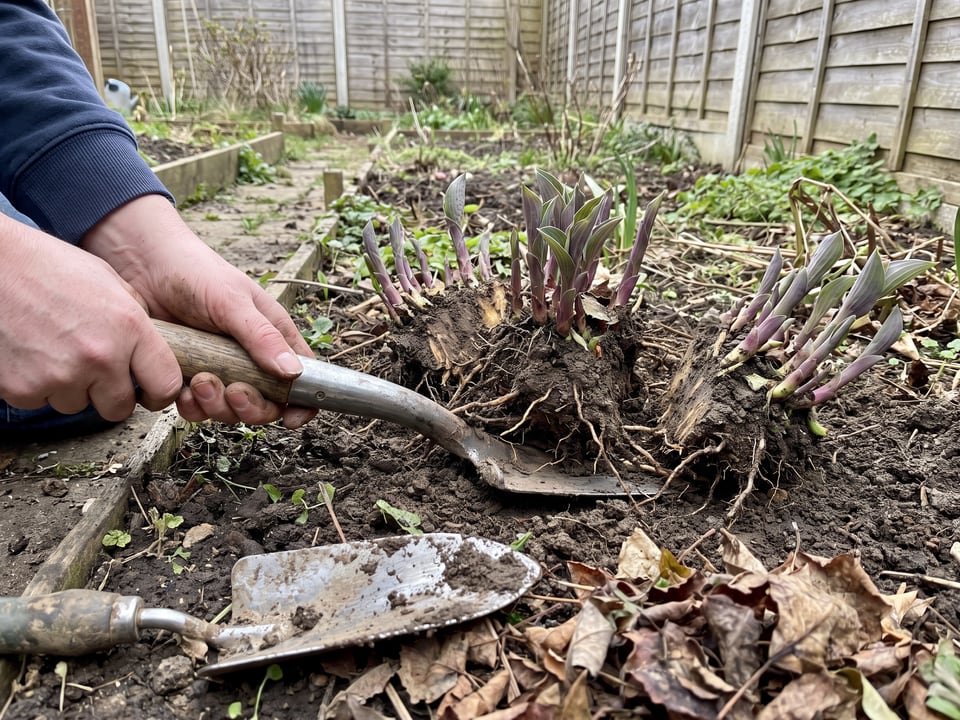
- Either slice a section off the edge with a sharp spade while the clump stays in the ground, or lift the whole clump out.
- Split the root mass by hand, with a trowel or with the spade. Each division needs at least one eye (UGA). SDSU suggests leaving a few leaves on each piece.
- Replant the divisions right away at the same depth, crown at soil level, and water well.
Use clean, sharp tools, as Clemson recommends.
When to cut back hostas
Cut hostas back in fall, after the leaves have died back. Clemson recommends removing the dead leaves and cleaning up around the plants then, to help control diseases and slugs.
To see roughly when that happens where you live, look up your first frost date in the fall planting calendar.
Do deer eat hostas?
Yes. Rutgers NJAES rates the hosta genus D, “frequently severely damaged,” on its deer-resistant plant list, the lowest of its four ratings. UGA says deer eat the foliage especially when other food is scarce, and that fencing or a watchful dog may be the only sure protection. If deer visit your garden, grow hostas inside a fence or near the house, and look at deer-resistant perennials for exposed beds.
Slugs and snails are the other main pest. UGA says they will eat hostas freely. Clemson mentions saucers of beer as the most popular remedy and warns against slug baits that can poison pets.
Do hostas come back every year?
Yes. Hostas are hardy perennials, and every cultivar in the catalog is listed as hardy to USDA zone 3. The leaves die to the ground in fall and new shoots come up from the crown in spring. If you are still sorting out which plants return and which don’t, see annuals vs. perennials.
Choosing a hosta for the spot
Pick by mature size first, then by light. Mini hostas like Blue Mouse Ears spread about 12 inches (30 cm), while giants need 5 feet or more. Browse all cultivars on the hostas hub, or see the full range of perennials.
For spring bulbs in the same beds, see how to plant daffodil bulbs for timing. For another long-lived perennial you plant in fall, read how to plant peonies.