How to plant peonies: depth, sun and spacing
Oct 2, 2026 · 8 min read
How to plant peonies: eyes 1 to 2 inches deep, 6 hours of sun, planted in fall. Depth rules for herbaceous, Itoh and tree peonies, cutting back and dividing.
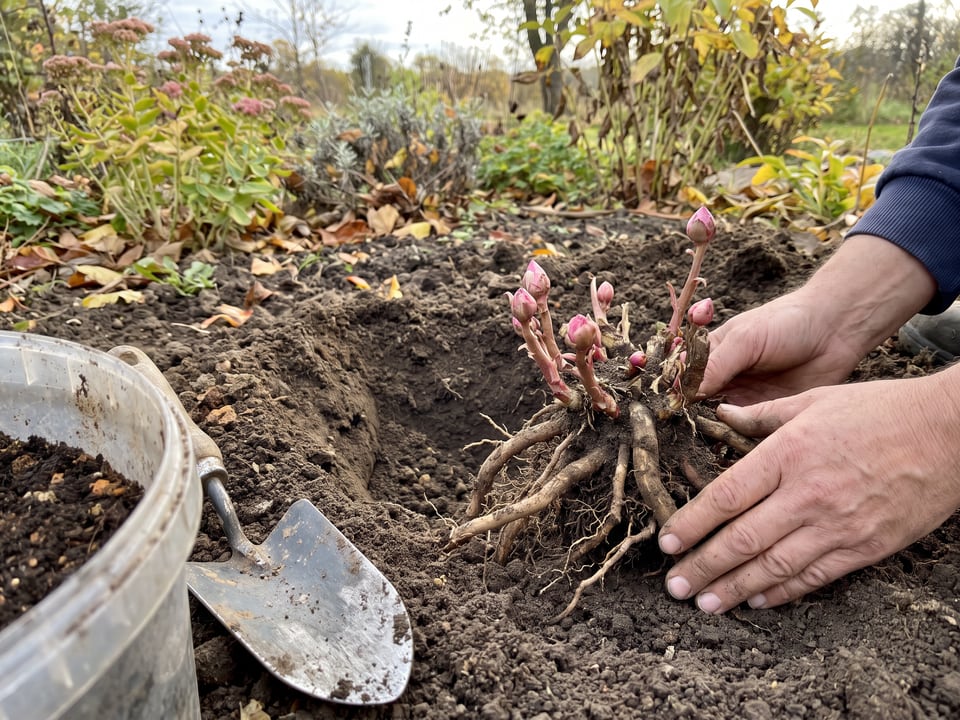
Plant peonies in fall. The American Peony Society puts the window at late August through October in most of the zones where peonies grow, and later in warmer climates. Iowa State narrows it to September for Iowa. Fall works because peonies do most of their root growth then, so a root set in September has weeks of cool, moist soil to anchor itself before the ground freezes.
Spring planting is possible, but it is the weaker option. The same American Peony Society page notes that spring-planted peonies make little if any root growth and lean on stored moisture to get through their first summer. The American Peony Society does not recommend spring planting. For the fall window and depth in your zone, enter your ZIP code in the fall planting calendar.
Planting peonies by type
The three groups you will find in the peony catalog share a planting season, but they go into the ground differently.
| Type | Planting time | Depth | Light |
|---|---|---|---|
| Herbaceous | Late August to October | Eyes 1 to 2 in (2.5 to 5 cm) below the surface | Full sun, 6+ hours |
| Itoh (intersectional) | Late August to October | Eyes 1 to 2 in (2.5 to 5 cm) below the surface | Full sun |
| Tree peony | Fall | Graft union 4 to 6 in (10 to 15 cm) below the surface | Full sun to dappled shade |
Herbaceous peonies are the classic garden type. They die to the ground every winter and come back from buds (eyes) on a fleshy crown. Sarah Bernhardt, Festiva Maxima and Coral Charm belong here.
Itoh peonies are crosses between herbaceous and tree peonies. Wisconsin Horticulture describes them as having short woody stems that still die back to the ground in winter, so in the garden you plant and cut them much like herbaceous peonies. Bartzella and Cora Louise are Itohs, and in our records both bloom in early summer, a little after most herbaceous types.
Tree peonies keep woody stems above ground all year and are usually sold grafted. Penn State Extension says the graft union of a grafted root should sit 4 to 6 inches below the soil surface, well deeper than the eyes of a herbaceous root. Taiyo and High Noon are in this group, and our records put tree peonies in mid to late spring, ahead of the herbaceous ones.
How deep to plant peony eyes
Set the uppermost eye of a herbaceous or Itoh peony 1 to 2 inches (2.5 to 5 cm) below the soil surface. Iowa State, Wisconsin Horticulture and Penn State give the same range, and the Missouri Botanical Garden calls it critical. For Itohs, the grower Walters Gardens gives 1½ to 2 inches (4 to 5 cm) for the crown, the same as for garden peonies. A peony planted deeper tends to grow healthy leaves and few or no flowers.
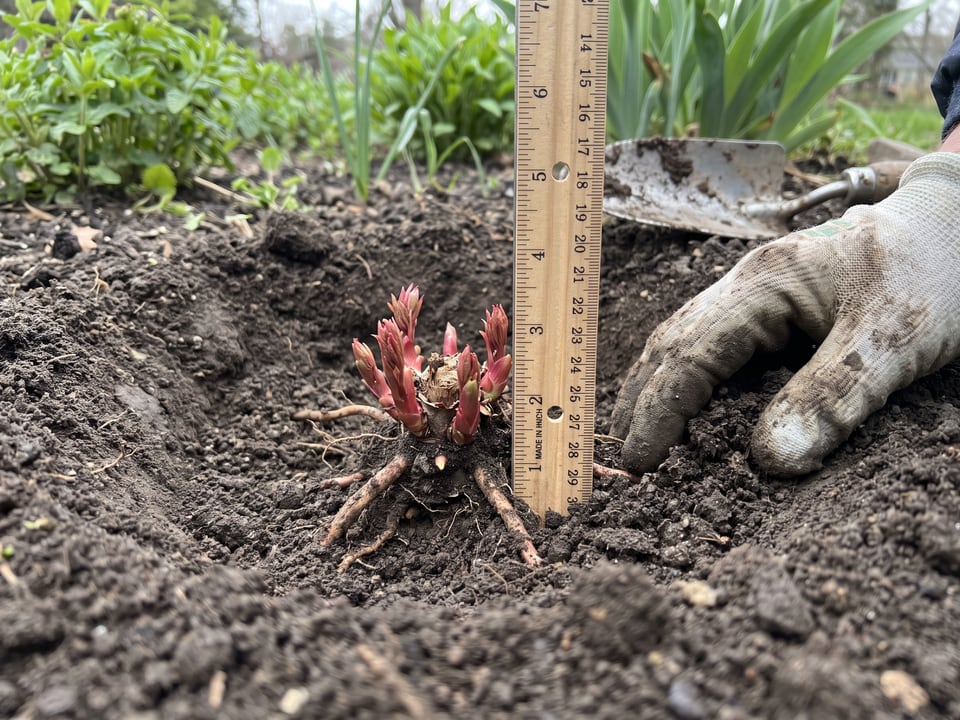
Soil settles after watering, so the depth is easy to get wrong. Missouri Botanical Garden recommends a hole 1 to 1½ feet (30 to 45 cm) deep and just as wide. Backfill the bottom, firm it, set the root so the eyes point up, and check the depth with a ruler before you fill the rest. Water it in and check again: if the root has sunk, lift it and add soil underneath.
When buying, Missouri Botanical Garden suggests divisions with three to five eyes. Missouri Botanical Garden lists plants with fewer than three eyes among the most common reasons peonies fail to bloom.
Do peonies need full sun?
Yes, herbaceous and Itoh peonies need full sun to bloom well. Wisconsin Horticulture defines that as 6 to 8 hours of direct sun, and Iowa State asks for at least six hours of direct sun. Wisconsin Horticulture adds that spacing plants for air circulation helps manage leaf diseases. In Iowa State’s list of reasons peonies fail to bloom, anything under 4 to 6 hours of direct sun is the first one.
Tree peonies are the exception. Penn State says they tolerate full sun to dappled shade, and their large flowers may last longer out of the most intense sun. If your only open spot gets afternoon shade, a tree peony is the better fit than a herbaceous one. In our records Taiyo, Kinkaku and High Noon are all listed for full sun or part shade.
Spacing matters for the same reason as sun. Wisconsin Horticulture gives 3 to 5 feet (90 to 150 cm) between plants for most peonies of any type. They stay in one place for decades, so plan for the mature clump.
Where not to plant peonies
Avoid three spots: shade, wet soil, and places where roots of trees and shrubs will compete. Missouri Botanical Garden, Wisconsin Horticulture and Penn State all ask for well-drained soil. Shade is the most common reason a mature peony stops flowering, and a crowded spot means you will be moving the plant later, which costs you bloom years.
Deer are less of a worry. Rutgers NJAES, in its list of landscape plants rated by deer resistance, rates peonies as rarely damaged. That is why they appear in our deer-resistant perennials collection.
When to cut back peonies
Cut herbaceous peonies to the ground in fall, after a hard freeze. Missouri Botanical Garden says to remove all foliage and stems from the bed every fall after a hard frost, and Wisconsin Horticulture says the same: cut the old leaves down in fall and destroy them. Throwing the leaves out instead of composting them removes diseased tissue from the bed.
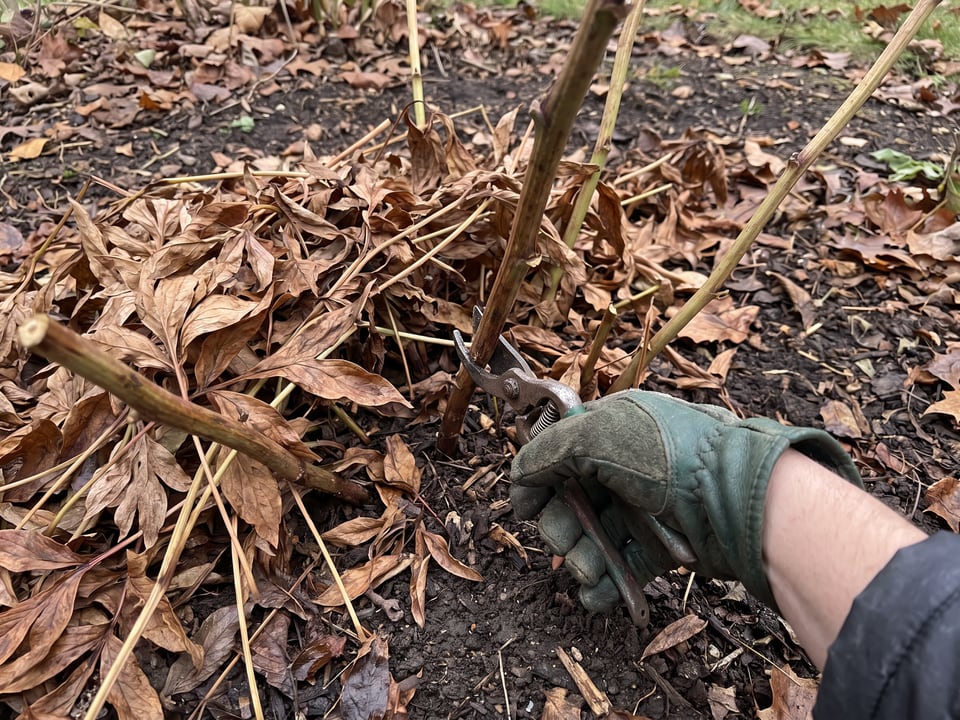
Don’t cut early: Iowa State warns that removing foliage in July or August weakens the plant and gives fewer flowers the next year. The leaves feed the crown all summer, so leave them standing until frost, even when they look tired.
Sources differ on Itoh peonies. Wisconsin Horticulture and Penn State say their stems die back to the ground in winter, but Walters Gardens says not to cut them all the way back in fall, because the lower stem often carries next year’s buds. Tree peonies are not cut to the ground. Their woody stems carry next year’s flowers.
For first-winter protection, the American Peony Society says to mulch new plantings with wood chips or bark after the soil has frozen, and to remove the mulch above the plant in early spring.
Why are my peonies not blooming?
Most often the peony is in too much shade or was planted too deep. Those are the first two causes in the Iowa State list. The full list splits into plants that never set buds and plants whose buds do not open.
No buds at all:
- Too much shade. Less than 4 to 6 hours of direct sun.
- Planted too deep. Eyes more than 2 inches below the surface.
- Recently moved or divided. It can take 2 to 3 years to settle in and bloom again.
- Too much nitrogen. Heavy feeding produces leaves at the expense of flowers.
- Clump too old and large. Very old clumps can stop flowering and need dividing.
- Plant too young. Peonies grown from seed take about 4 to 5 years to bloom.
- Leaves removed early. Cutting foliage in July or August weakens next year’s display.
Buds that do not open:
- A hard freeze in May damaged the buds.
- A dry summer the year before weakened the plant.
- Botrytis blight hit the buds in cool, wet weather.
- Thrips damaged the buds.
- Low fertility left the plant without enough vigor.
If the plant was put in last fall, be patient. Wisconsin Horticulture says transplanted peonies may not bloom the first year, but blooms increase in the years after.
Transplanting and dividing peonies
Move or divide peonies at the same time you would plant them: early fall. Iowa State calls September the best month in Iowa. Dig the whole clump, cut it into divisions with at least 3 to 5 eyes and a good piece of root, and replant at the same 1 to 2 inch depth. Iowa State says it can take 2 to 3 years for moved or divided plants to bloom again.
Picking peonies for a long season
Because the three groups bloom at different times, you can stretch the season by planting one of each. In our records tree peonies such as Shima-Nishiki open in mid spring, herbaceous peonies like Red Charm in late spring, and Itohs like Bartzella in early summer. Check each variety page for its zones: most herbaceous peonies in the catalog are listed for zones 3 to 8, while the Itohs start at zone 4.
For more fall planting, see how to plant daffodil bulbs, another fall planting job, and how to plant hostas if part of your bed is too shady for peonies. If you are unsure whether peonies count as perennials, annuals vs perennials covers it, and the full perennials collection lists what else comes back each year.